
AI Agents Are Coming for Creative Work But Not How You Think
Why Ghana's digital leap could help creatives scale, not disappear, and what's needed to make that real.
The headlines are everywhere: AI is coming for creative jobs. Designers, writers, musicians, everyone is worried about being replaced by algorithms. But here's what those fear-driven articles miss: AI agents don't have to replace African creatives. They could amplify them.
The difference? It's all in how the technology is implemented. And Ghana's digital landscape offers real-world insights into what's possible.
Over the coming weeks, we will be releasing a 3 part series of thought pieces that delve into the themes outlined above examining the potential role Ghana could play, unpacking challenges rooted in historical initiatives, and exploring opportunities for the continent at large. These reflections will draw on examples from adjacent industries and organizations currently reshaping Africa’s development landscape.
Framing the Question
What if African creatives built the next wave of AI, not just used it?
That's the deeper story buried beneath the automation headlines. Ghana, in particular, presents a case not just for adaptation but authorship--for becoming architects of AI systems shaped by local needs, data, and cultural intelligence.
What Are Agentic AI Systems?
Agentic AI systems are autonomous digital frameworks that can reason, plan, and act independently. Think of them as highly capable assistants that manage full workflows with minimal oversight.
Unlike traditional generative AI tools (which require constant prompting), agentic systems can:
Research client needs
Draft proposals
Schedule meetings
Track project progress
Learn from outcomes to refine future actions
This matters because where generative AI might compete with creative output, agentic AI supports the process surrounding that output. It reduces the operational drain, allowing creatives to focus on what they do best: creating.
Ghana's Digital Foundation
Ghana’s embrace of digitalisation and its vibrant startup scene offer fertile ground for building an agentic AI economy—one that enhances creativity rather than replaces it.
69.8% internet penetration (source: DataReportal 2024, confirmed by GSMA and World Bank reports)
113.1% mobile connectivity -- more active SIM cards than people (source: DataReportal 2024; ITU corroborates this trend for West Africa)
7.95 million social media users, with a median age of 20.8 (source: Kepios 2025; cross-referenced with Ghana Statistical Service projections)
$127 million in startup funding raised in 2024 (source: Africa: The Big Deal 2024 tracker, validated by Disrupt Africa reporting)
The UAE Partnership: A Strategic Infrastructure Play
How Ghana’s $1 billion AI infrastructure deal with the UAE could be a turning point—or another false start. And what it will take to break Africa’s “compute poverty trap.
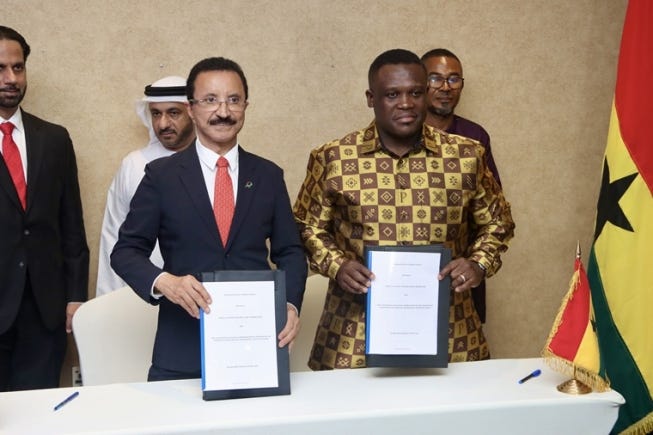
In May 2025, Ghana signed a $1 billion memorandum of understanding with the United Arab Emirates to establish what could become West Africa's most significant AI infrastructure project. The 25 km² Ningo-Prampram technology hub represents more than just another tech park--it's a direct response to Africa's most critical AI development bottleneck.
Here's why this matters practically: Currently, African AI developers face what researchers term the "compute poverty trap." According to reports by the Partnership on AI and UNDP, only 1% of African data scientists have on-premises GPU access, and only 4% can afford cloud GPU time--generally budgeted at $1,000/month or less. This constraint limits meaningful experimentation and deep model iteration.
To put this in perspective, industry estimates for training sophisticated language models vary significantly depending on the model's size and complexity. Smaller or earlier models may cost in the hundreds of thousands to low millions - for example, GPT-3 training costs have been estimated at approximately $4.6 million. However, cutting-edge frontier models require substantially more resources.GPT-4 training costs are estimated between $63-79 million according to different analyses.OpenAI's total training expenditure across all models reached approximately $3 billion in 2024
These figures represent computing costs and may not include other expenses like data preparation, infrastructure, and personnel. Some experts predict that billion-dollar training runs for next-generation models are already underway or imminent.For African developers, this creates an impossible barrier to entry--they can't build the AI systems they need because they can't afford the infrastructure to experiment, iterate, and scale.
Ghana and the UAE’s commitment of $1 billion to build the Ningo-Prampram tech hub may be tackling one of the continent’s biggest development challenges.
However, it's important to note that there is limited public information about what the UAE-Ghana hub will actually encompass. While the partnership could theoretically provide centralized, subsidized access to high-performance computing, this remains largely speculative. Infrastructure projects of this scale in Africa have a mixed track record. Ghana's Petronia City project, launched in 2013 as a proposed 2,000-acre oil and gas hub to serve West Africa's energy industries, exemplifies this challenge. Despite ambitious plans and backing from prominent developers, as of December 2023, major development has yet to begin after more than a decade. The project was designed to include residential, office, industrial, commercial, leisure, and hospitality spaces, with the first phase alone featuring a four-star hotel, office buildings, schools, and luxury villas. Yet recent site visits show work "at a standstill," raising questions about whether it's becoming "yet another white elephant".
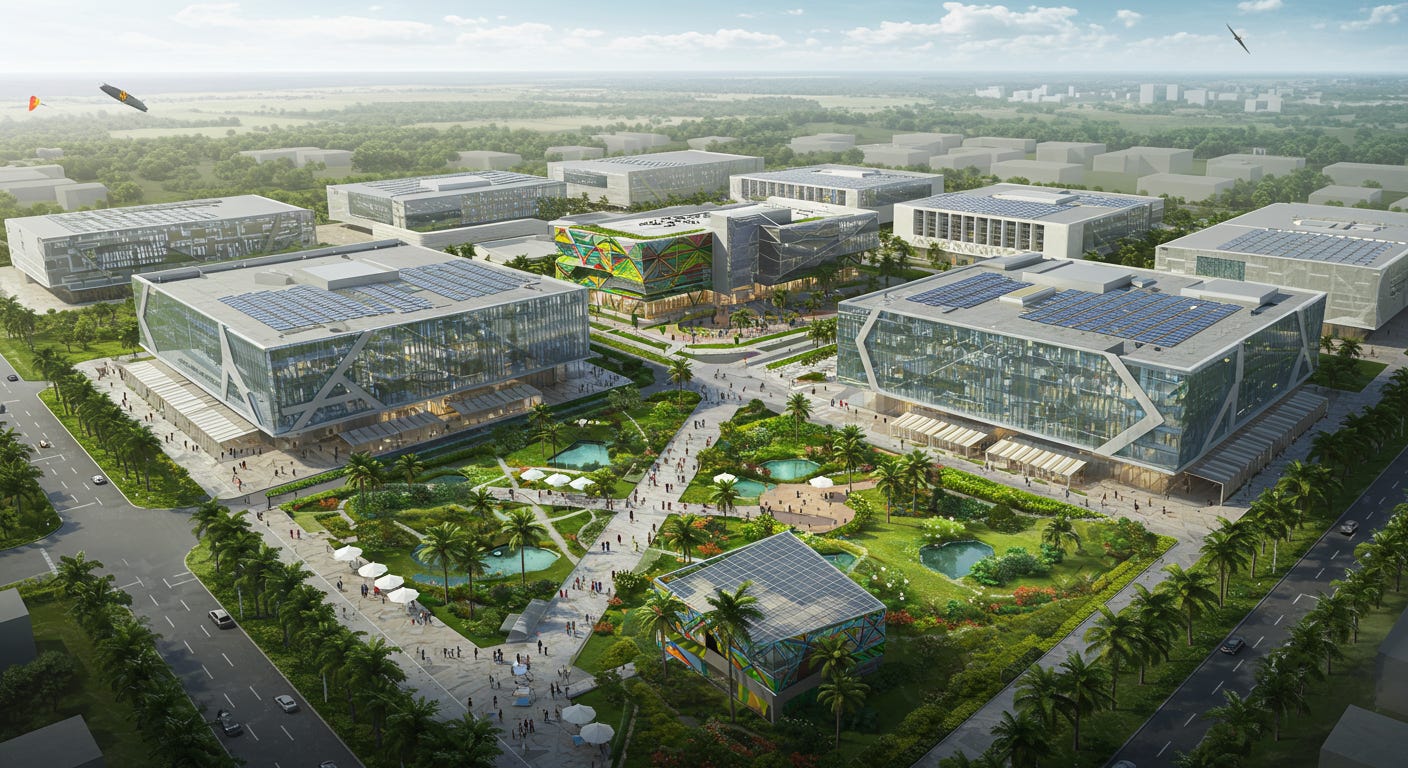
Ghana's history with ambitious tech infrastructure projects raises legitimate questions about execution. Hope City, announced in 2013 as a $10 billion ICT park designed to employ 50,000 tech workers, remains unbuilt after more than a decade. Like the current UAE partnership, Hope City began with presidential fanfare and international backing, yet construction never materialized following economic downturns and partner complications.
The pattern is concerning: ambitious announcements, high-profile launches, then extended delays or abandonment. For the UAE-Ghana AI hub to succeed, it must overcome the implementation challenges that have plagued similar projects.
The 25-kilometer facility is designed to be operational by 2027. If successful, this infrastructure could unlock computational capacity for creative applications that are currently out of reach—enabling training on African music to capture polyrhythmic nuance, developing computer vision that reflects African phenotypes, and building NLP systems that preserve oral storytelling in creative writing.
In the next article of our series we will explore why African creatives are still left out of most AI systems, despite the progress. We’ll explore the key barriers, from data and infrastructure to skill access and algorithmic bias.